
Center Channel Speaker Buyer’s Guide: Everything You Need to Know
In a home theater setup, the center channel speaker is typically placed directly above or below your television. And while every speaker in a surround sound system plays a role, the center speaker is arguably the most critical.
Why? Because it handles the vast majority of dialogue and on-screen sound effects and basically does all the heavy lifting. So if you’re aiming for cinematic clarity and immersion, this is the speaker that will carry the emotional weight and narrative flow.
If you’re not sure what to look for, read this Center Channel Speaker Buyer’s Guide and you’ll walk away with a clearer understanding of what makes a great center speaker, how to choose one that fits your system, and how to get the best performance out of it.

Is a Center Channel Speaker Necessary?
Technically, no—you could skip it. Most AV receivers are designed to reroute the center channel audio to the front left and right speakers if no dedicated center is connected. But, doing so compromises the integrity of the soundstage and can muddy the dialogue.
Another benefit of having a dedicated center speaker is control. Without one, you can’t independently adjust the volume of dialogue. It gets blended with everything else coming from the front speakers, which can result in muffled or buried speech during action-heavy scenes.
>> Center Channel Speakers for Every Setup <<
Is a Bigger Center Speaker Always Better?
Not necessarily. When choosing a center channel speaker, it’s wise to prioritize clarity over brute force. Start your system build by selecting the best center speaker your budget and space allow. Once you have that anchor, build out the rest of your speakers to match.
In terms of woofers—the drivers that produce mid-to-low frequencies—larger isn’t always better for this application. Smaller woofers tend to respond more quickly and accurately to vocal frequencies, which is ideal for dialogue intelligibility.
But woofer size is just one piece of the center speaker puzzle. Tweeters, which reproduce the highest frequencies, also play a key role. Hard-dome tweeters, often made from materials like aluminum or titanium, can produce a crisp, articulate sound that helps dialogue cut through the mix. In contrast, soft-dome tweeters, often made of silk or textile blends, tend to have a smoother, more relaxed character.
Some center channel speakers use tweeters with waveguides or horn-loading. These designs help direct the sound toward the listening area, improving focus and reducing room reflections—especially useful if your seating position is directly in front of the TV.
Build Quality and Cabinet Design
The construction of a center channel speaker’s cabinet plays a critical role in how clean and natural it sounds. A poorly built enclosure can vibrate or resonate with the drivers, introducing unwanted coloration—especially in the midrange, where dialogue lives.
Look for speakers made from dense, non-resonant materials like MDF (medium-density fiberboard), often with internal bracing to reduce vibrations. Some higher-end models include curved edges or tapered designs to minimize diffraction, which can distort sound as it leaves the speaker.
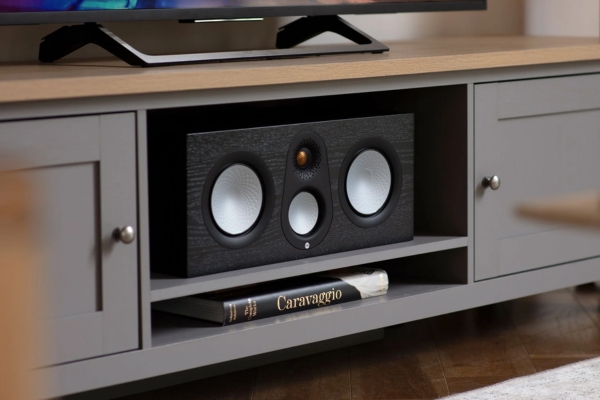
Crossover Design and Why It Matters
One of the most overlooked yet critical elements of any center channel speaker is the crossover network. This internal component determines how audio frequencies are divided between the speaker’s drivers—usually the tweeter and the woofers.
A well-designed crossover ensures that each driver only handles the frequencies it’s best suited for, leading to clearer sound and less distortion.
There are two main types of crossovers to be aware of:
- Passive crossovers are built into the speaker itself. These use resistors, capacitors, and inductors to direct frequencies appropriately without any external power.
- Active crossovers, on the other hand, are external and often found in powered speaker systems or digital processors within AV receivers. These offer more precision but are usually reserved for advanced setups.
In most quality center channel speakers, the crossover frequency—the point at which audio transitions from the woofer to the tweeter—typically falls between 2kHz and 3kHz. That’s right in the heart of the human vocal range, which means any crossover issues will directly affect how dialogue sounds.
A poorly executed crossover can result in phase issues, where the soundwaves from different drivers interfere with one another, causing muddiness or hollowness. High-end center speakers usually use more precise crossover designs with better components, ensuring a seamless blend and maintaining dialogue clarity—even in complex scenes.
Matching Your Front Speakers
To maintain a seamless front soundstage, your left, center, and right speakers should be well matched both tonally and in size. This concept is known as voice matching—ensuring that sounds moving across the front of the screen transition smoothly without noticeable tonal shifts.
The best way to achieve this is to purchase all three speakers from the same brand and series. Always bear in mind, manufacturers often design speaker families with shared components and voicing, which helps maintain sonic consistency.
Size matters too. While your center speaker doesn’t have to be identical in dimensions to the left and right units, extreme mismatches should be avoided. For instance, pairing a compact center with towering full-range mains might lead to an imbalanced sound field.
If you plan to use the system for music as well as movies, consider the tonal character of the tweeters. For example, if you enjoy the warmth and softness of silk-dome tweeters in music playback, make sure your center speaker uses a similar tweeter type to maintain cohesion across content types.
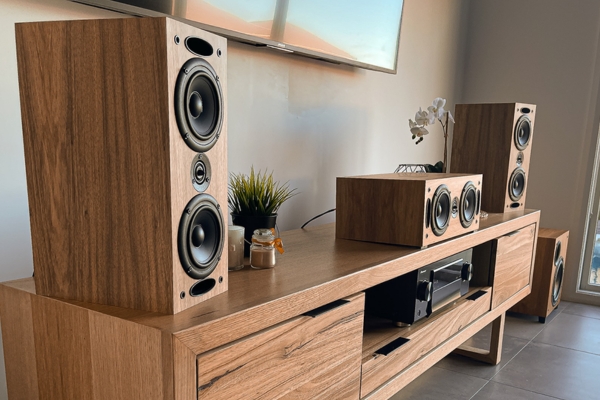
Off-Axis Dispersion and Listening Angle
Not everyone sits directly in front of the TV, which is why off-axis performance is so important. A good center channel speaker should maintain clear, balanced dialogue even if you’re sitting off to the side or slightly above/below the speaker.
Some designs include a waveguide or horn-loaded tweeter to control dispersion and direct sound more precisely toward the listening area. Others might use angled driver arrays to widen the horizontal spread.
If you have a wide seating area or an open-plan room, prioritize a center speaker that performs well across a broad listening angle—this ensures everyone hears the same level of clarity, no matter where they’re sitting.
Speaker Terminals and Wiring Options
Most center speakers connect using standard binding posts, but the design and flexibility of these posts can vary. Higher-quality models often feature gold-plated five-way binding posts, which accept banana plugs, bare wire, or spade connectors for a secure and corrosion-resistant connection.
Some speakers also support bi-wiring or bi-amping, meaning they have two sets of terminals—one for the tweeter and one for the woofer section. While not essential for most setups, it gives advanced users more control or allows for future upgrades.
Can Any Speaker Be Used as a Center Channel?
Technically, yes—but practically, not always. Most center channel speakers are horizontally oriented for a reason: they’re meant to be placed under or above your display.
While it’s possible to use a vertically-oriented bookshelf speaker as a center, placing it on its side can lead to uneven sound dispersion and comb filtering (a type of interference that degrades clarity).
Soundbars, particularly powered ones, cannot be used as center channel speakers. They’re self-contained audio systems with their own amplification and processing, which are not designed to accept external speaker-level input.
Passive soundbars do exist, and these include separate left, center, and right channels in a single enclosure, with discrete speaker terminals for each. These can function with a surround receiver if configured properly, but again the performance won’t match that of a center speaker.
>> Center Channel Speakers for Every Setup <<
Optimal Center Channel Placement and AV Receiver Settings
Proper placement enhances performance. Aim to position your center speaker as close to ear level as possible. If it’s below or above the screen, angle it toward the listener. Many center speakers come with angled cabinets or adjustable feet to assist with this.
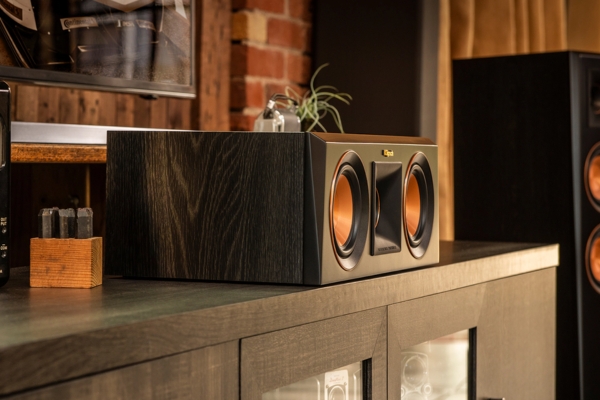
If you’re still struggling with dialogue clarity, explore your AV receiver’s settings. Most receivers include a dialogue or vocal enhancement mode, which boosts the frequency range of the human voice (typically between 300 Hz and 3 kHz).
Alternatively, you can manually increase the volume of the center channel by a few decibels. Some models even offer dialogue lift—a digital processing feature that virtually raises the center channel output to screen level for more accurate voice localization.
If you watch movies late at night, your receiver’s dynamic range control or night mode can help. These settings reduce the volume difference between quiet and loud scenes, allowing you to hear dialogue without being blasted by sudden explosions.
Room Acoustics and Calibration
Even if you invest in a high-end center channel speaker, its performance can be greatly affected by the room it’s in. Hard surfaces like wood floors, bare walls, and large windows can create sound reflections that blur or brighten dialogue, while plush furniture and carpeting absorb sound and can mellow it out.
The room’s shape and size also influence how sound behaves, particularly in the mid and high frequencies where most vocal information resides.
This is where room calibration comes into play. Most modern AV receivers come equipped with some form of automatic speaker calibration system.
They work by uisng a microphone to measure how your speakers sound in your actual room, then adjust the audio output using digital signal processing (DSP). The result? Cleaner dialogue, better balance, and more accurate imaging from your center channel.
For even better results, consider basic acoustic treatment. Adding a thick rug, sound-absorbing panels, or even a bookshelf behind your seating area can reduce problematic reflections and improve overall clarity.
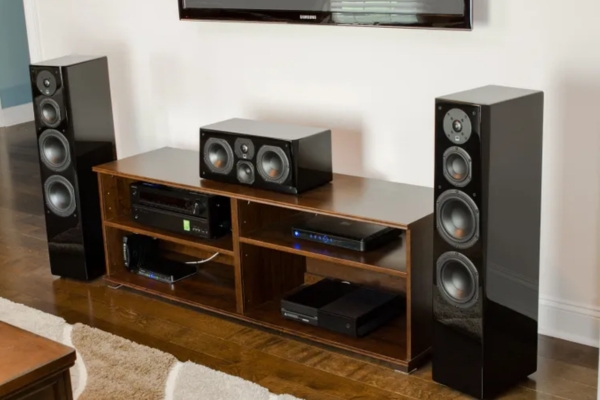
Key Features and Specifications to Consider
- Speaker Materials: The construction of drivers influences sound. For instance, silk-dome tweeters offer a smooth, mellow sound, while metal domes provide crispness and sparkle.
- Sensitivity Rating: This tells you how loudly the speaker plays given a certain amount of power. Measured in decibels (dB), higher sensitivity means more volume with less power. If you have a modest receiver, look for a speaker rated at 90 dB or higher.
- Power Handling: Match your AV receiver’s RMS (continuous power) output to the speaker’s recommended power range. This ensures clean performance and prevents distortion.
- Impedance: Measured in ohms, this indicates the electrical resistance of the speaker. Most home theater speakers are rated at 6 or 8 ohms. If you’re considering a 4-ohm speaker, make sure your receiver can handle it—these lower-impedance models draw more current and require more robust amplification.
Building Your Soundstage Starts at the Center
Choosing the right center channel speaker is about anchoring your entire home theater experience. This speaker carries the weight of dialogue, directs the action, and ties the front soundstage together.
From understanding driver design and crossover quality to factoring in room acoustics and system calibration, every detail plays a role in how clearly and naturally your system communicates the story on screen.
Whether you’re a seasoned audiophile or building your first surround system, investing in a properly matched, well-placed, and thoughtfully calibrated center channel speaker will make the single biggest impact on your cinematic immersion, and hopefully you found this Center Channel SPeaker Buyer’s Guide of great use.
Always, take your time, trust your ears, and build the center of your sound system truly the center of your attention.